
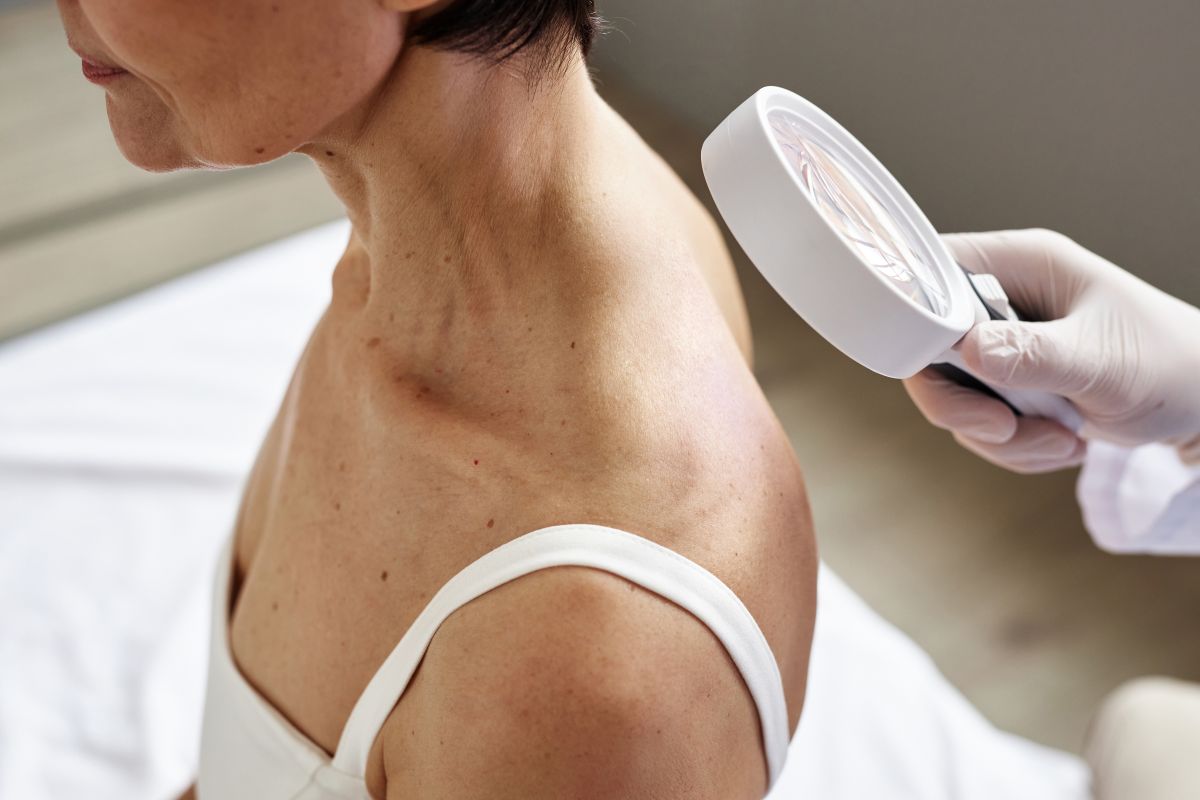
Almost everyone has at least one birthmark even if they’re very small. Usually noticed in infancy, some birthmarks fade with time and others stick it out as we grow. Either way, birthmarks are typically harmless, but there are some situations where birthmarks are linked to early warning signs of skin cancer. According to Dr. Edgar Martinez of U.S. Dermatology Partners Plano, “Knowing the warning signs and changes in birthmarks that may indicate skin cancer is essential to diagnosing and treating these skin conditions in the earliest stages when it’s most treatable.” In this blog, Dr. Martinez explores the answers to common questions like can birthmarks be skin cancer and when should I talk to a dermatologist about birthmarks?
Not All Birthmarks Are Risky
There are many types of birthmarks, and not all of them present a risk for skin cancer. The most common, benign types of birthmarks are port-wine stains and strawberry marks. Port-wine stains take their name from the reddish-purple coloring that is similar to a deep red wine called port. Port-wine stains are vascular birthmarks that most often appears on the head, neck, and arms. While permanent, port-wine stain birthmarks do not increase risk for skin cancer. Infantile hemangiomas, commonly known as strawberry marks, are another type of vascular birthmark. They develop during infancy and typically shrink as they grow up. These birthmarks are typically red with a bumpy surface similar to strawberries, and they can develop anywhere on the body.
High Risk Birthmarks to Know
Melanoma and pigmented birthmarks have one thing in common – they involve the skin’s pigment cells. While vascular birthmarks are almost always benign, pigmented birthmarks, especially those that start as moles, have an increased risk of developing melanoma. Below, Dr. Martinez breaks down the types of birthmarks that are more likely to be indicative of skin cancer.
Congenital Melanocytic Nevi: When Birthmarks Start as Moles
Congenital melanocytic nevi (CMN) are moles that are present at birth or during the first couple of weeks of life. They develop when pigmented skin cells cluster together. They can be very small or cover larger patches of skin. Small and medium sized CMN (up to 20 cm) represent only a sightly increased risk for skin cancer. However, larger CMN (20 cm or larger) show an increased risk for skin cancer with 5% of patients developing melanoma in their lifetime. Look for the following warning signs:
- Jagged borders
- Multiple shades within the mole / loss of color
- Ulceration / bleeding
Dysplastic Nevi: Unusual-Looking Moles That Can Mimic Melanoma
Dysplastic or atypical nevi are moles that appear clinically abnormal, including larger size, color variations, ill-defined borders. Patients with multiple dysplastic nevi are at significantly higher risk for skin cancer, such as melanoma. These tend to appear in childhood through early adulthood. Anyone with one or more of these atypical nevi should perform skin cancer self-exams at least once a month. Unique features of dysplastic nevi include:
- Blurred or jagged edges
- Mixed pigmentation or coloring different from other moles
- Larger than other moles, especially if greater than 6 mm
- May be flat with raised areas
Other Birthmarks Linked to Risk
While large CMNs and dysplastic nevi are most often linked to skin cancer, there are a few other types of moles that are potentially risky because they mimic melanoma, requiring professional evaluation. These types of birthmarks include:
- Nevus spilus – darker patches of skin with black spots throughout. Typically benign, these nevi can be linked with melanoma in some situations.
- Halo nevus – mole with lighter-colored ring around it that’s caused when the immune system fights against pigment-producing cells. These may be benign, but moles with a halo-like circle and atypical features are at increased risk of melanoma. For this reason, it’s important to see a dermatologist if you notice halo nevi developing.
- Spitz nevus – pink, domed moles that develop in young children and adolescents. While these moles are usually benign, some can be aggressive and be early melanoma signs, so they need to be carefully examined.
Warning Signs of Skin Cancer in Birthmarks
According to Dr. Martinez, “Knowing the warning signs of skin cancer that may be found in birthmarks is important. If patients identify these areas of concern early, it’s much more likely we can diagnosis and treat skin cancer effectively. I recommend my patients perform skin cancer self-checks at least once a month, especially if they have a personal or familial history of skin cancer.” When examining skin each month, pay special attention to birthmarks, moles, and other marks on skin and look out for the ABCDEs of skin cancer:
- A Asymmetry – the lesion is different on one side.
- B – Border – ridged, blurred, or uneven edges rather than smooth sides.
- C – Color – a difference in color compared with similar marks or having various shades within one mark.
- D – Diameter – lesions larger than 6 mm (the size of an average pencil eraser).
- E – Evolving – any birthmark, mole, or other mark that changes, especially if it changes rapidly.
In addition to the ABCDEs of skin cancer, look out for the following birthmark cancer risk factors when examining skin and contact a dermatologist right away:
- Pain, tenderness, or itching.
- Sores that don’t heal or that return.
- Spots that bleed or ooze.
- Rapidly appearing and developing marks.
Why Early Detection Matters
The Skin Cancer Foundation promotes the importance of early skin cancer detection and treatment because it’s more treatable when caught early. One of the most important examples of this is melanoma, which has a 99% five-year survival rate when diagnosed and treated in the localized stage before it spreads to other areas. For this reason, regular skin cancer self-exams and annual professional screenings are essential, especially for those with birthmarks and moles. Be systematic in examining skin and noting any irregularities. Don’t skip the more difficult to see spots like the scalp, nail beds, and bottoms of feet. For those with very large CMNs or numerous dysplastic nevi, you may want to talk to your dermatologist about digital mole mapping to monitor even very small changes over time.
Prevention Tips
You can’t prevent birthmarks, but you can reduce your risk for developing skin cancer with regular self-exams and following prevention tips like:
- Stay sun safe – apply sunscreen daily to any areas of exposed skin and reapply regularly throughout the day. This is especially important for kids.
- Choose the right sunscreen – look for a broad-spectrum sunblock with a sun protection factor (SPF) of 30 or higher.
- Seek shade – when outdoors for extended periods, seek shade regularly and take breaks from the sun.
- Wear protective gear – hats, gloves, ultraviolet protection factor (UPF) clothing, and sunglasses place a physical barrier between skin and the sun’s UV rays.
- Don’t take UV risks – avoid tanning beds and unnecessary sun exposure. Those who have one or more sunburn are at dramatically higher risk for skin cancer, so it’s important to avoid unnecessary UV exposure and damage.
When to Consult a Dermatologist
Dr. Martinez says, “Those with pigment birthmarks should consult with a dermatologist at least once a year for a skin cancer exam and more often if they find anything unusual during self-checks.” Still wondering when to see a dermatologist? Make an appointment if you answer yes to any of the following questions:
- Have you noticed your birthmark changing?
- Are you developing new moles or lesions?
- Do you have a personal or family history of skin cancer?
- Do you have a large CMN or multiple dysplastic nevi?
Schedule a Skin Cancer Screening
Are birthmarks dangerous? Not usually, but if you notice something strange or different about your birthmark, it may be time to talk to a dermatologist about scheduling a skin cancer screening. During this appointment, your dermatologist will examine skin for signs of skin cancer, answer any questions, and plan treatment as needed. When you’re ready to get started with the team at U.S. Dermatology Partners, just take a few moments to fill out our scheduling request form. We look forward to hearing from you.
Find a location near me
or