
By Lana Pine; Fact checked by: Afton Woodward and Rebecca Dufner, M.D. of U.S. Dermatology Partners Plano
Patients often use eczema, psoriasis and dermatitis interchangeably, and it is easy to see why. All three can cause red, itchy, inflamed skin, and they frequently show up in similar places on the body. But they are not the same thing, and understanding how they relate to each other can make it easier to talk with a doctor and understand a diagnosis.
Dermatitis is the umbrella term
Dermatitis simply means inflammation of the skin. It is an umbrella term for a wide range of inflammatory skin conditions. Eczema itself is considered a type of dermatitis, since dermatitis broadly refers to conditions that cause skin inflammation. That is part of why the terms get used loosely. When a doctor says someone has “dermatitis,” they are often describing a category that eczema and several other conditions fall into, not naming a single specific disease.
Where eczema fits in
Eczema is itself a broad term, not one single condition. There are seven common types of eczema, including atopic dermatitis, contact dermatitis, dyshidrotic eczema, neurodermatitis, nummular eczema, seborrheic dermatitis and stasis dermatitis, with atopic dermatitis being the most common. Eczema is common. It affects more than 31 million people in the United States alone, and it often starts in childhood, though it can appear or persist into adulthood. Symptoms include dry, itchy skin that can develop into rashes, small bumps or blisters that ooze or crust over.
How psoriasis is different
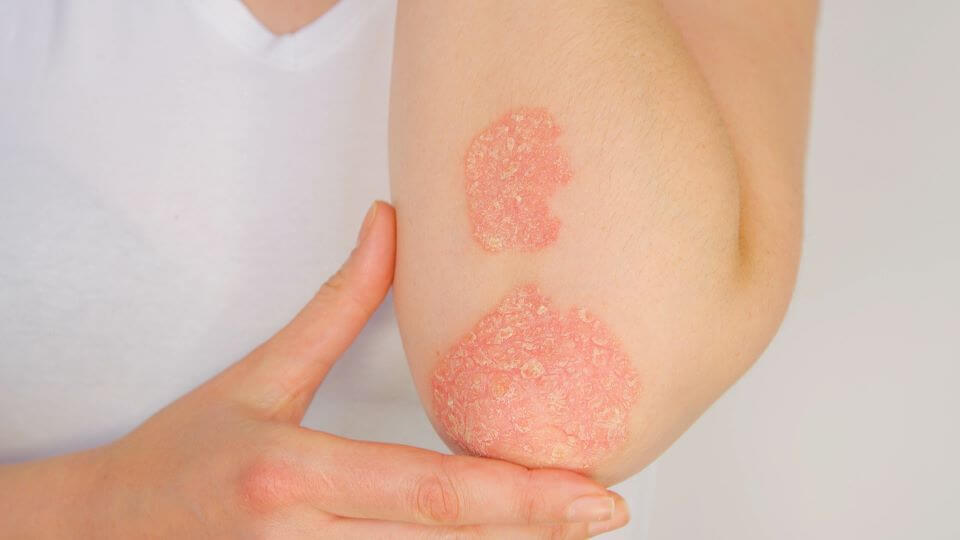
Psoriasis is a chronic skin condition that develops when the immune system causes skin cells to grow too quickly, and the extra cells pile up into thick, scaly patches that can appear red, pink or white. Unlike eczema, psoriasis is considered an immune-mediated condition with autoimmune features — an overactive immune response drives inflammation that causes skin cells to grow and turn over far faster than normal. It is also less common than eczema. Psoriasis affects about 2% to 3% of the general population.
Psoriasisis considered a systemic condition. The most common other “system” that is affected is the joints (psoriatic arthritis). Patients with psoriatic arthritis tend to have a more advanced, multi-system form of the disease, which can also affect eyes (uveitis), but also cardiovascular disease (hypertension) and metabolic disease. Patients are also at an increased risk for mental health issues such as depression.
Telling them apart
A few practical differences can help distinguish the two conditions. Eczema most often appears in the flexor surfaces of the body, such as the inside of the elbows and behind the knees, while psoriasis tends to show up on the outer, extensor surfaces, like the outside of the forearms, the fronts of the knees and the shins. Itching also tends to differ. Both conditions cause itching, but eczema itching tends to be more intense than psoriasis itching.
When to see a specialist
Because eczema and psoriasis can look alike, especially in early stages or mild cases, a dermatologist is often the best resource for an accurate diagnosis. Treatment approaches differ depending on which condition is present, and getting the right diagnosis early can prevent unnecessary frustration with treatments that were never going to work for the underlying condition. While there is no cure for either eczema or psoriasis, both can be managed with topical medications, systemic medications, light therapy and lifestyle changes.
If you are dealing with persistent red, itchy or scaly skin, tracking where it appears, how it feels and what seems to trigger flares can help a dermatologist sort out which condition, or combination of conditions, is behind it.